Friday, November 21, 2014

Blog Post 5

How To Perform A Self-Breast Exam

It is important that people of all ages perform self-breast exams at least once a month. These self-exams can be performed in many different locations (i.e. shower, in front of a mirror, or lying down) and they will not interfere with your daily life. There are five easy steps to performing a self-exam.

Step 1: Look at your breasts in the mirror with your hands on your hips.                

If you see any of the following changes you should consult your doctor immediately:
  • Dimpling, puckering or bulging of the skin
  • A nipple that has changed position
  • Redness, soreness, rash or swelling   

Step 2: Raise your arms and look for the same changes.

Step 3: While you're at the mirror, look for any signs of fluid coming out of the nipples. 

Step 4: Feel your breasts while lying down. Use your right hand to feel your left breast, and your left hand to feel your right breast. Move the finger pad of your hands in a circular motion around the breasts.

Step 5: Lastly, feel your breasts while standing or sitting. Use the same hand movements as in Step 4. 
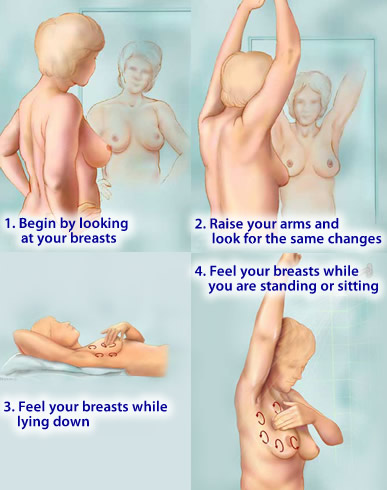


I encourage you all to spread the word to family, friends and loved ones about the importance of self-breast exams! These exams could contribute to early detection of breast cancer, saving the lives of individuals. For more detailed instructions on how to perform a self-breast exam, please visit http://www.breastcancer.org/symptoms/testing/types/self_exam/bse_steps


References:

1. The Five Steps of a Breast Self-Exam. (n.d.). Retrieved November 21, 2014, from http://www.breastcancer.org/symptoms/testing/types/self_exam/bse_steps

Friday, November 7, 2014

Blog Post 4


What Should You Ask Your Doctor After a Breast Cancer Diagnosis?

A breast cancer diagnosis is a lot to take in. I know that it can be intimidating and you may be at a loss for what to say. However, it’s important to ask your healthcare provider a lot of questions in order to ensure that you thoroughly understand your diagnosis. If you are in shock after your diagnosis, I suggest asking your healthcare professional if you can take a step outside to take some deep breaths and collect your thoughts. If you don’t want to do this, go home and write down a list of questions that you think of and ask your provider these questions at your next appointment. A few questions that you may want to ask include:

  • What are my treatment options? 
  • What stage of breast cancer do I have?
    •  What does this mean? 
  • What risks and side effects should I expect to experience from treatment?
  • What can I do to make this process easier?
  • Has my cancer spread to my lymph nodes or other organs? 
  • Should I change my diet or exercise routine because of diagnosis?
  • Will I be able to have children after my treatment?


And remember, don’t be afraid to collect your thoughts and ask questions. You need to understand your diagnosis so that you can decide what steps to take next. 


References:


1. Questions to Ask My Doctor About Breast Cancer. (n.d.). Retrieved November 7, 2014, from http://www.cancer.org/acs/groups/cid/documents/webcontent/003284-pdf.pdf

Friday, October 24, 2014

Blog Post 3


A Day-to-Day Guide for Breast Cancer Patients

After diagnosis it’s easy to focus on all the negative things and the long road ahead. You may fear the treatment and its side effects. This is all common; remember you aren’t the only one experiencing these same symptoms. It’s important to note these symptoms are a major focus of your healthcare team and are incorporated in your overall treatment plan.

Living with cancer not dying from it.

Tips to Reduce Stress:
·      Open up to your oncologist
·      Find out all your treatment options offered in your treatment plan
·      Talk about side effects
·      Stay organized 
·      Keep positive attitude
·      Relax
·      Exercise
·      Eat a well-balanced diet
·      Rest and sleep


Give yourself time and be patient. Adjust. After your operation, swelling will go down, bruising will fade, and scars will gradually become less obvious. Scars will take a little longer to fade, but they will. Find out as much as you can about your personal condition. Communicate with other people that are in the same situation and make some time for your self each day.  Stay up to date on how your cancer is responding to the treatment.

You are not Alone. About 1 in 8 U.S. women (about 12%) will develop invasive breast cancer over the course of her lifetime. In 2014, there were more than 2.8 million women with a history of breast cancer in the U.S. This includes women currently being treated and women who have finished treatment.


To order a copy of "The Metastatic Breast Cancer Series: Guide for the Newly Diagnosed" visit: http://mbcn.org/education/category/guide-for-the-newly-diagnosed 


Questions To Ask Your Doctors:
1.  How long will it take for me to get back to normal life?
  1. Is there any counseling available to help me with the emotional side of breast cancer?
  2. Are there medicines to help reduce menopausal symptoms, such as hot flashes?
  3. Will the medicine cause side effects?
  4. Is there any practical help I can get?
  5. How can I reduce tiredness?
  6. Would complementary therapies help me to cope with depression, tiredness or anxiety?
  7. Is there anyone who can help me with financial issues, including claiming benefits?    


    References:

    1. Living with breast cancer surgery. (n.d.). Retrieved October 24, 2014, from http://www.cancerresearchuk.org/about-cancer/type/breast-cancer/living/living-with-breast-cancer-surgery

Tuesday, October 7, 2014

Blog Post 2


Tips For Families Dealing With A Breast Cancer Diagnosis


The individual with breast cancer is not the only one affected. Family and friends may also feel the affect of this diagnosis. However, I am here to help! Here are some tips for coping with a breast cancer diagnosis:

1. Be supportive! You may notice changes in your loved ones mood. Try to be sensitive to this. The medications or treatments may be causing these mood changes.


2. Encourage the independence of your loved one! Of course, we want you to be there for them whenever they need you in this tough time. However, being active and independent will help her to regain some self-reliance and keep her attitude positive.

3. Make sure you take care of your needs (rest!) so that you can meet the needs of your loved one to the best of your ability.

4. Accept help from other family members and friends!

You may also find that your stress levels are greatly increased during this time. It is so important that you do your best to keep these stress hormones at a reasonable level in order to ensure that you have a healthy mindset when assisting your family member. To keep stress levels down:


1. Exercise! Exercise releases endorphins. Endorphins have morphine-like effects and they make you happy!

2. Eat lots of whole foods—fruits, vegetables, whole grains!

3. Stay positive!

4. Meditate. Take a few moments out of each day to take deep breaths and center your thoughts.

5. Make sure you are getting enough sleep.

Here is an article that may help you to better understand how to explain cancer and cancer treatment to children: http://www.cancer.org/acs/groups/cid/documents/webcontent/002605-pdf.pdf 


References:

1. Coping With Cancer in Everyday Life. (n.d.). Retrieved October 7, 2014, from http://www.cancer.org/acs/groups/cid/documents/webcontent/002801-pdf.pdf